Being a good student, I already had some of the history of Hamamatsu down to an ‘elevator pitch’ but let’s see what I missed. The bikes were not going anywhere but I was still teasing myself with thoughts of what the top floor had in store for me. First I had to make my way through the manufacturing exhibition.
As you’d hope, there was some interactive stuff. Pulling levers to rotate a car door on a fully automated robot production line was a good one -great sounds. I knew from a little inside tip that there was another machine which would deliver me a Suzuki egg! (It had a car in it … booooo) You were walked through the casting process and got to see some models too.
Can ya tell what it is yet?
I’ve got a bit of a thing about casting since making my own ally ashtray in Big Pete’s GoP many moons back …
There was some stuff around the factory itself and the sheer scale of the site can be seen from the aerial photos taken through the years. (come on! get to the bikes already!)
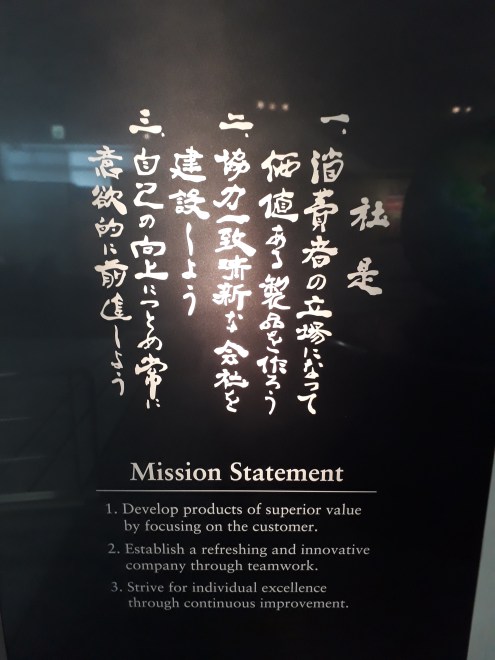
Hamamatsu from the Air Suzuki – Mission Statement
I moved up to the next floor and came pretty much face to face with The Man Who Started It All. Not the most recognisable face, sure but here he was. The man who had used his engineering skills and business acumen to redirect Suzuki from a failing loom making business, to an upstart car manufacturer closed down by the war as ‘non essential manufacturing’ , reinvented AGAIN as a motorcyle and small utility manufacturer, and onto the business that continues to thrive today. It was pretty emotional. Plus, I hadn’t really spoken to anyone all day and this guy was willing to listen a while.
The man of ingenuity – Michio Suzuki
And finally – here they spread in front of me, I CAN SEE THE BIKES! Be cool. Breathe.
Suzuki: In the beginning …
I’m still on early history trip now and am duly reminded that from day 1 the business purpose was to serve its customers. Right now there was a gap in the market for cheap and easy to maintain transport that everyone could use. Suzuki’s engineers calculated that 36cc gave sufficient output having been combined with a pedal drive and the Power Free E2 was born in the early 50s.
The handsome Diamond Free model
Development continued at pace in Hamamatsu. It was 1954 and the team were set up at the prestigious Mount Fuji hill climb – it was show time. Their win there in the 90cc class put them firmly on the manufacturer’s map. They were contenders.
As well as speed and power trials, Suzuki also wanted to demonstrate the reliability and tenacity of their new machines. A pair of brothers spent 2 years riding this ‘Diamond Free’ 58cc model 47000km between Bangkok and Paris. The road network was barely developed at that point and you can only imagine the challenges along the way, but the machine survives to this day, on show here in Hamamatsu.
By the early 60s. Suzuki were ready to take on the world renowned challenge, the ultimate test of rider and machine – the Isle of Man TT Race. The team ran machines from 1960 but it wasn’t until Mitsuo Itoh took the ride in the 50cc class on the RM63 that Suzuki got to lift their first TT trophy.
The TT winning Suzuki RM 63 The RM63 – small but powerful! Suzuki for the Win! Eat My Dust.
Keep posted as I head further into the 60s, 70s and dip a toe into what Suzuki had in store for the 80s
Comments Off on Oldskoolsuzuki meets Don Hill at Rooster Racing
At the end of January I got a chance to go and visit a man who has probably forgotten more about building and tuning 90s GSXRs than most of us will ever know. His name is Don Hill and he owns Rooster Racing.
What made this opportunity to visit Don’s workshops special was that it’s not something he offers very often. He is almost adverse to attention and publicity, preferring to hand pick the people he builds bikes for. The reason for Don’s approach became clearer as the day wore on.
Don Hill and the Rooster Racing team at Donington endurance legends 2018
Don Hill
I first became aware of Don’s work when my friend Adrian McCarthy (AKA Mole) told me he was going to be one of 3 riders racing Don’s Rooster Racing GSXR powered Harris at the 2018 endurance legends event at Donington. When I was there, I got a quick look round the bike in the pit garage. The build quality and the finish were something very special.
That same year I started my own race career ( if you can call it that). Racing at Eastfortune on my home built GSXR1100 Slabside. I quickly learned that 3 of the fastest GSXRs in my post classic senior class were all built by Don at Rooster Racing. I would like to say that’s why they were so much faster than me but the truth was that was entirely down to me. With Don’s Slabside based 1216 engines routinely and reliably knocking out over 160 bhp, I can’t see my home built Slabby getting close even if my riding skills improve.
Adrian’s Championship winning GSXR1100 slabside built by Rooster Racing
I got chatting to Don in the pits at Eastfortune last year between my races. I had been suffering from some fuelling problems and Mole and I and the rest of the team had been struggling to solve the problem. Don turned up and took around 2 minutes to sort it. We chatted again after my last race and he agreed that I could come down and learn more about what he was doing and write something for OSS.
Rooster Racing
There were two main reasons I was intrigued to know more about Don’s work. Firstly, I was impressed by the performance and the reliability of the engines he was building. Secondly, Don’s talents don’t stop at engine building and tuning. He fabricates the frame and swingarm modifications, builds his own exhausts systems and as if that wasn’t enough, he produces the most amazing paint work too. There aren’t may people who can single-handedly build a race bike to such a high standard. I just needed to know more.
Mole was going down to Don’s to pick up freshly painted body work and wheels for his 2019 wet bike. So I hitched a lift down to meet Don on his his home turf and learn more about the work that he does.
When we arrived Don took us into his main hanger size workshop, he put the heating on and then presented us with us with tea and bacon butties. I liked him already.
While Mole and Don talked I had a wander round looking at some of the motorcycle exotica that peppered the workshop.
Don and Mole talk shop
GSXR Engine tuning
Don was in the midst of building a new Machine shop for his gas flow bench. The flow bench was situated in another location until Don has completed the extension. Don promised me a return visit when all of the work was complete so that we could do a more detailed feature on it.
,We talked about his fastidious approach to head work. He will routinely spend 200 man hours on a head between porting it and gas flowing it. When we talked about costs, I quickly worked out that he probably ends up earning about £3 an hour on a head. It was at this point that I started to realise Don was an out and out perfectionist. He was not motivated by cost or profit. His motivation was quality. This was not Don’s day job either.
Don explained his method of gas flowing a cylinder head. Don would always gas flow with the carbs on. Not any old carbs but the actual carbs that were going to be used on the bike. He acknowledged that everyone had their own approach but this was his. Engines were built to each racers specific requirements. Those requirements often came down to where the bike would be raced and how and where the rider wanted the power to develop. No one engine would be the same.
Don explains the varying engine characteristics that he has tailored for different racers
GSXR frame fabricaion
Don had a GSXR slabside that he was mid way through building for a racer from the ground up. This included all of the frame and swingarm mods and a very trick aluminium breather tank.
Ground up Rooster Racing GSXR Slabside race bike
GSXR exhaust fabrication
Don then talked us through the exhaust systems that he builds to go with his engines. He talked about about the importance of narrowing the headers at the manifold and ensuring that the pulses from the matched cylinders worked in unison at the collector box. I was out of my depth but I nodded like I understood.
Rooster Racing’s hand made exhaust systemsDon explains the virtues of collector box configuration
Rooster Racing paint
Mole’s freshly painted body work and wheels were laid out for collection and they were perfect. Don was clearly a man of artistic talents too as he explained his love for ornamental wood carving and shared some pictures of his work. Looking closely at the paint work than Don had completed for Mole, it bore all of the hallmarks of a perfectionist, just like everything else that Don put his hands to.
Mole inspects his new paint job by Don Hill
Quality and integrity are inseparable
As the morning wore on and Don and I talked some more I realised what a rare individual he was. When I say this, I mean Don seemed to be able to bring the the same methodical, well rehearsed quality, to everything he did. There was also something unique about the way Don viewed the bikes and the riders that he worked with.
When he built a bike for someone he maintained an genuine ownership like concern for the bike and the rider’s fortunes. This was the reason Don chose those who he built for so carefully. He had to be sure that they the rider would be prepared to do things Don’s way. He doesn’t build parts of bikes, he builds a complete performance package. The performance came from each part of the bike working in unison.
Mole was a trained motor mechanic and was no stranger to building his own machines. He had won a number of championships on his own builds but since meeting Don he now deferred to Don on all major decisions on race bike performance. As Mole put it “when Don tells you to do something you don’t argue you just do it”
Rooster Racing’s Harris Endurance bike
I left Don’s workshop with a deep respect for his skills and his ethos. Don understood the high stakes for a racer, having raced for many years himself when he was younger. Racers had partners and families to provide for. The performance, reliability and ultimately the safety of the machines Don built meant more than just winning. Lives were at stake and that responsibility was something that weighed heavily on Don’s conscience.
I concluded that Don was a man of great skill, who would always put quality first. He would never be afraid to walk away if he felt that his approach was unwelcome, unappreciated or compromised. His commitment to that approach and his integrity left me feeling that I could implicitly and completely trust Don. I can’t think of a more important time to trust someone than when they’re building you a race bike.
Oldskoolsuzuki will return to Rooster Racing later in the year. In the meantime, don’t call Don, he’ll call you.
This month’s bike of the month is a tale of both resurrection and evolution. Plucked from an insurance sale, this slightly fire damaged, pretty standard machine was rescued by nightrider. It was quite a rare find – especially the other side of the Atlantic. The decision is what we at OSS would call ‘a no brainer’.
We’ve been watching the story of this machine since the oldskoolsuzuki.info site itself was resurrected and as is often the case with projects progress sometimes stalls. Over the last 3 years we’ve seen a pragmatic mix of make do (when the OEM spares are hard to get) and mend.
With some advice and moral support from folk who have done the same thing as you and the balls to give it a go (or know when to sub it out) most obstacles can be over come. The proof is in the riding but this ES is easy on the eye in that striking blue squareness it wears so well.
So the GS 1100 ES has now returned to it’s rightful duty as a smile inducing muncher of miles. And I have no doubt the story and evolution will continue.
It’s a great bike. Who wouldn’t want it in their fleet?
2 strokes… the smell, the noise, the power band, the teenage memories, your first (indicated) 100mph. Some of us grew up around them and personally I still have a hankering for one. A lovely X7 would make an excellent choice.
Speaking of excellent and X7 in the same sentence, it was time to choose this month’s BOTM and when I saw alfiestorm’s finished bike it had to be it. When did we last have a bike of the month without cams?
As many projects start, it was bought originally to simply do up a little and get it MOT’d and on the road. Upon investigation however it soon transpired that there more work to do and indeed an opportunity to make it really nice.
The bike was dismantled, the engine was stripped, rebored and rebuilt. Lots of powdercoating and paintwork.
The tank was found to be really nasty and full of filler. Lots of work done and oh… those spannies! The result is a bike that looks ‘period right’ yet isn’t pretending to be standard… much like the one I’d have loved to have had back in the day.
So alfiestorm, your lovely little X7 is this months BOTM.
Comments Off on The quality is remembered long after the price is forgotten
At the beginning of August oldskoolsuzuki took a stand at the VJMC show at Donington. I decided I would go down for the weekend and hang around drinking beer and looking at bikes.
As the weekend progressed and my bike ogling and beer drinking continued I began to reflect upon how much my personal opinion on what constitutes a desirable bike has changed over the last 25 years.
Looking back to when I was in my 20s my opinion was driven almost entirely by 1. Aesthetics and 2. Affordability. If I liked the way a bike looked and it was affordable, I would buy it. Even in my 30s little had changed when I bought a tatty 1982 Suzuki Katana for £500. From the age of 13 when I first set eyes on the Katana’s crazy German/Japanese design, I had wanted one.
Although my work on the Katana started out with a largely aesthetic goal in mind, I was quickly drawn into a very different mindset. My journey led me me beyond aesthetics alone, into the world of functional performance parts that, to the untrained eye, often looked awkward or even aesthetically out of place. If you knew their significance, however, they took on a functional beauty all of their own.
So, my view of what constituted a desirable bike had gradually distorted. What makes a desirable bike for me, these days, hinges almost entirely on the sum of it’s parts rather than the whole. More accurately, form now follows function.
Where once I would stand back from a bike to take in it’s lines and evaluate it’s stance and other wanky bullshit of that nature, I’m now more likely to be found crawling around underneath it, taking in every bolt, bracket and component. If it has the right parts and it has been well put together, to me, the engineered, functional simplicity, that some might find ugly, becomes a thing of great beauty.
We now live in the world of Facebook Instagram and Twitter and there are more shared opinions about what is right and what is wrong than ever before. My opinion is just one more of the many opinions shared and although I represent a unique type of anorak, I live happily with the knowledge that I am not alone and I have a place to go, away from the internet, to indulge my world view.
I still remember when OSS spent a few agonising years on Facebook while the forum was up on the ramp. The problem with most of the open and untethered internet is that literally anyone can pitch up and offer his or her opinion on content and knowing what they are talking about is purely optional. I remember on the old Facebook page someone had posted up a picture of a really nice EFE fitted with a turbo. It’s fair to say that a more brutal looking engine and assembly of purposeful plumbing, would have been hard to find. While most of us were liking it and fawning over it, one learned chap commented, with great authority, that he didn’t think the oversized frame tubing looked very good and that it ruined the lines of the bike. Somebody quickly corrected him on the fact that this was actually the feed from the turbo to the plenum and not the frame tube. “I still don’t like it” he replied ” it looks out of place and ruins the lines of the bike”.
Every time I see an overpriced CX500 cafe racer with a brown leather seat, bathing in the glow of an Instagram filter, I am reminded that there are many who will never see beyond style alone. Each to their own. Fashions come and fashions go but quality never goes out of style.
A walk around any race paddock and you quickly realise that these guys have always believed that function dictates form.
We built oldskoolsuzuki.info so that we would not be alone in our lust for expensive components, trick engineering and the love of admiring the work of those that are able assemble said parts to form unique performance motorcycles. Looking around our stand at Donington, I was reminded that we did the right thing.
Quote of the weekend at Donington goes to a passer by on our stand, who after taking a long and careful look around the bikes on the stand, turned with a smile and said “you guys are fucking mental!” Naturally, we took that as a compliment.
So here is to continuing to beg, borrow and engineer the very best parts we can, safe in the knowledge that the quality always remains long after the price is forgotten.
Comments Off on A picture paints a thousand words……
When we re-launched the site we were keen not to fall into the traps that the previous forum had suffered from. As we saw it ,those were bandwidth issues and forum maintenance issues.We also wanted to fund the site independently and transparently, without donations.
Bandwidth
So as far as the bandwidth issues were concerned we decided to host the entire site remotely. In order to keep hosting costs low we restricted the size of uploads ( pictures) In the time that the site was down everyone naturally and understandably became very used to the seamless and automatic picture resizing prowess of platforms like Facebook. This meant that resizing images prior to posting had become a total pain in the arse. We now believe that this is ultimately affecting the desire for members to share pictures and content on the forum. We concede that this is counter productive.
Forum Platform
We trialled a few platforms before we settled for IPB. The platform is fully supported by the company that makes it which means we don’t have to do do much to keep it in good health. It is mobile responsive and offered the best balance between cost and functionality. Unfortunately it did not have a picture resizing plug in that would allow any size of picture to be uploaded and resized automatically. We hoped IPB would develop this but they have not, yet. This lead to many members using photobucket and other picture hosting platforms to save having to resize pictures.
Picture hosting
Now, while remote hosting of pictures from your own account is easier than resizing as well as being easier on our storage capacity it’s not ideal for the info stored in the threads. The reason for this is that photobucket links break for all sorts of reasons. For instance if you delete pictures on your hosted account then the links on the forum no longer work and threads that were once full of pictures fill up with annoying black boxes with a message saying that the image is no longer available.
We like pictures
So, here’s what we have done to remedy the situation:
You can now upload any size picture that you want. We have lifted the restriction on file size.
We want to store all site pictures here rather than hosting them elsewhere.
When we need to we may have to increase our hosted capacity but that wont be soon.
Use the yellow link which says choose files to upload your pictures.
We have also repaired the glitch that was affecting hosted pictures links.
We could have just said “we’ve fixed the picture problem” but we wanted to take the time to explain what we where trying to achieve as a way of explaining the decisions we have made. Communication black outs were another pit fall we wanted to avoid.
Please do your best to keep file size down and help us save space. We will routinely delete pictures from the for sale and wanted sections once the posts are dead, in the interests of maintaining space.
Comments Off on Horsepower talks and bullshit walks
There are few points in a bike build that have more potential for self back patting and/or self loathing than the inaugural visit to the dyno man. It is the place where a curved line graph and 3 magic digits coldly define the fruits of a long winter spent chasing those elusive extra horses.
Dyno runs don’t normally come cheap but thanks to OSS member Havoc ( Tom Davidson) we have secured the use of a dyno provided by RTR in Nottingham. Dyno sessions will be 20-25 minutes for just £25. Each dyno run will come with a full print out as well as advice from RTR’s proprietor.
The date for the planned dyno day will be Sunday the 31st of July starting at 10am and it will be held at RTR Motorcycles, 7 Moorbridge Road, Bingham, Nottingham NG13 8GG. The venue is just 2 units down from Allens Performance so we will try to arrange carb jets to be available for tweaks between runs.
In order to make the day financially viable we’ll need 12 people so once we have 12 people paid up the event will go ahead. If we don’t have 12 people by the end of May we wont do the event. Details on how to sign up and pay can be found here on the forum. If we have more than 12 people and our costs are covered any surplus will go to the air ambulance fund.
Tom has also arranged for a catering van so that members can keep up their strength on the day.
If you are looking for a dyno run to set up your bike or you just want to know what it’s pushing out at the back wheel £25 is not a lot of money.
Naturally we will start a competition where members can claim a BHP figure before the start and depending on the results we might resurrect the OSS bullshit award for the biggest difference in the dyno result.
Please bear in mind that your bike’s mechanical well being is entirely your own responsibility and OSS takes no responsibility for mechanical failure or any resulting mechanical damage that may occur during your dyno run.
Rene is on location today so he asked me to publish this article on his behalf.
Many of you will instantly recognise the name knarF and you will know the importance of the OSS build project associated with it. For those that are new to OSS, we need to provide little bit of background.
On the 13th of July 2006 the OSS community lost a close friend KnarF (Frank) when he died suddenly due to freak allergic reaction to something he ate while on holiday. At the time, we only learned this sad news quite a bit later when Mr7/11 (OSS site founder) was contacted by KnarF’s family to ask “what to do with all those bike bits”. Like so many of us, Frank had been collecting parts to build his dream bike for a number of years, while still always having a fairly tricked out bike on the road, it’s a familiar OSS condition.
After getting over the initial shock of loosing a close friend , Mr7/11 spoke with KnarF’s family and agreed it would be a fitting tribute to try to complete and realise KnarF’s dream of a Yoshimura GS build. Mr7/11 came back to the OSS community and asked that we all share that commitment to build Frank’s dream bike. Mr7/11 saw this is as his and the OSS community’s obligation to Frank and his family; to posthumously build the bike Frank had been dreaming of but would sadly now never have the opportunity to complete.
Thus the KnarF GS build began. The project got it’s own board on the forum and a legend was born. Parts were gathered from all over the world and the whole of OSS community rose to the occasion lending their support through parts, engineering, painting, powder coating, tuning, expertise , know how, encouragement and enthusiasm.
Mr7/11 led the project, with a lot of help from many generous site members. We all watched as Frank’s dream bike took shape before our very eyes. The KnarF GS was finished in 2007 in time for the deadline and revealed to the world at Circuit Park Zandvoort .
The bike was track tested at Assen and I still remember standing in awe as the bike went through the pit lane at onto the track to do what is was made to do. I watched with a sense of great pride as it promptly slaughtered a H#nda Fireblade on its maiden laps.
After the KnarF GS first appeared at Assen , it was campaigned for a good year or so as a proper classic racer by a site member Ron. After a while news of Ron and the KnarF GS went quiet. Ron went missing and with him the Knarf.
I never gave up hope of finding the KnarF GS again and over the years I picked up rumours and snippets of information about it’s whereabouts and it’s well being. More recently there were talks about it being found and returned but as it so often goes with some things, for one reason or another they were never followed through. I kept hoping that it would one day magically turn up.
Those hopes finally became a reality when I recently got a message from Fred on my phone; “call this number”. When I did I found my self speaking to a guy who I don’t personally know but who appeared to be familiar with all things OSS. Most importantly he told me he knew where the KnarF bike was.
In the end it turned out it ended up in the hands of a mutual friend, who was unaware of what the bike was and what it meant to a lot of people. Most importantly he agreed to return the bike to the OSS community.
So today marks the return of a long lost friend and the story of this bike and the community of OSS, who built it continues.
July the 13th 2016 will mark ten years since we lost our friend KnarF. It gives me the greatest pleasure to announce that we will be setting out to get the bike back to the state and specification that it was in when it was first finished in time for that important anniversary and I hope that once again we can call upon the help of the OSS community .
Each month, the site is carefully scoured for the very best offerings from the technical and project sections to justify the award of the accolade ‘Bike of the Month’.
This month’s choice demonstrates the versatility of the Old Skool Suzuki in adapting to different careers. In a game where form follows function, there is little on this machine that hasn’t been tweaked, fettled or upgraded in order to achieve the very best performance results – whatever the job.
Congratulations to you and your machine johnny1bump!
Comments Off on Hanmā-shin Hamamatsu- The Hammer God of Hamamatsu- A brief history.
Ancient depiction of Hamna-shin
Up until the early 90’s Hanma-shin could be found in the Suzuki factory at Hamamatsu where he diligently watched over the work of Suzuki’s designers and technicians, blessing their work with his divine and mighty hammer and scroll. Legend has it that his hammer is made from the very same meteorite that crashed to earth and killed the Dinosaurs. It is also said that the in-line four Suzukis of the 80’s and early 90’s owed their explosive power and durability to the thunder of his mighty hammer, which he divinely bestowed on each and every machine that rolled off the production line. It is also written that he was never without his sacred scroll of engine tuning spells which were attached to his hammer handle by the power band from a GT750.
The story goes that only one man ever got to view the contents of his sacred scrolls. He was a young mechanic named Pops who, after glimpsing their contents, was promptly forced to flee in fear of divine retribution. Some say the Hanma-shin never fully recovered from the trauma. Things really started to go down hill for him shortly after that when he refused to bless a water cooled in-line four engine that was in development at the factory. He was rarely seen again after that.
By the late 90’s there were whispered rumours that night watchmen at the factory reported older production lines for EFEs and oil cooled GSXR engines just starting up of their own accord. Technicians working on Suzuki’s latest models reported missing front ends and swing arms as well as other cutting edge cycle parts. The legend goes that somewhere in the factory there is a hidden room where Hanma-shin has built a stable of the most perfect old skool Suzukis. The bikes that Suzuki should have built but never did. They are rumoured to be the perfect blend of old skool grunt and cutting edge bling.
For years after his disappearance there were reports of H*nda Firebl@des in the staff car park being found smashed. The management of the factory put this down to badly driven delivery trucks but staff reported that the bikes very clearly looked like they had been smashed by a huge mash hammer.
A long serving Suzuki executive told us that all rumours and sightings had abruptly ended around about the same time Suzuki had introduced the water-cooled Bandit. He said he thought this had been the last straw for Hanma-shin.
I am pleased to end this sad story on a high, for after many years in the wilderness, Hanma-shin has finally mastered the wonders of the internet. After months of surfing inane, confused and frankly pointless motorcycle “web dwellings” ( as he calls them) he was on the verge of raising his mighty Hammer to smash his 10th computer of the day when the “sage oracle” ( this is what he calls Google) suddenly spoke to him of a distant clan of mortals by the name of the OSS, who had not yielded but had instead stayed true to the ancient ways, forsaking all other things. Since then he has carefully observed that the OSS too live by the hammer and scroll and in turn has come to realise that the OSS is an Island sanctuary in all the interweb and indeed in all the world. Perhaps here, he thought he might find lasting peace.
Here at oldskoolsuzuki.info he truly believes he has found his spiritual home. A place were fellow Luddites burn the midnight oil in secret rooms toiling to create the perfect Oldskool Suzukis by pilfering incidentals from modern machinery. He also loves the rules so much, that he has a laminated copy and slipped it in beside his sacred scrolls. Henceforth he has pledged his mighty hammer and his blessing to our cause.
Hanma-shin has agreed to allow us to use his hammer as our symbol and his image as our emblem on our “interweb dwelling” ( website) on our machines and on our “tunics” ( hoodies n’ that).
Thank you Hanma-shin, may your blessing give us success and your hammer protect us.
OSS- Hanma-shin emblem for the back of our tunics?
The new OSS logo. Hanma-shin’s mighty hammer.
Privacy & Cookies: This site uses cookies. By continuing to use this website, you agree to their use.
To find out more, including how to control cookies, see here:
Cookie Policy