Many of us will be familiar with the term “chequebook build”. If you are not, it’s a term used to describe a bike that has been built with no expense spared and it also means the owner has commissioned all the work by others with virtually no work done by them. If your chequebook is big enough and you schedule everything effectively you could rattle out something very cool in a matter of months.
This month’s bike of the month is the polar opposite of a chequebook build. That’s not because it isn’t dripping in high-quality components or because it hasn’t been assembled with great care and attention to detail. This bike is at the other end of the spectrum for two important reasons. Firstly, the owner doesn’t have a massive chequebook and secondly the only way the owner has been able to afford to build a bike to this standard is by taking 10 years to build it. During that time, he has built several other bikes all of which he has sold along with hundreds of other parts that he has refurbished and re-sold. All the money he has made from doing that has gone into buying the parts he wanted to build this bike.
When his money dried up, he got to work generating more funds through building another bike to sell and all the time he kept refurbishing or repairing parts and upselling them. There was never any question of compromising on the quality of this build. In fact, the quality kept getting better as time went on.
This year the bike was finally complete enough for it to be rolled out onto our stand at the Scottish Bike Show earlier this month. Having watched this build grow from a frame tank and swinging arm 10 years ago, it was rewarding to finally see a decade’s journey finally nearing completion. It was also good to see the bike being admired by so many at the show.
This bike started as frame number 0014 from the very talented Gav at GIA Engineering. Sadly, Gav passed away just last year but those that know their special frame history will know that if you bought a Spondon frame to fit an oil-cooled GSXR engine back in the day chances are it was built by Gav. The GIA frames were a progression of everything Gav had learned about frame building at Spondon, taken to the next evolutionary level.
The engine was painstakingly hand-built by Barry Armstrong the owner. It is based on a GSXR 1127 engine, but the crankcases have had 300 hours lavished on their insides removing seams and sharp edges and mirror polishing them to improve oil flow.
The Crank has been lightened and balanced and the Wiseco 1216 pistons sit on Carrillo rods inside a billet block by WSR. The head was ported by Roger Upperton with 1mmm oversized stainless valves with heavy-duty Ape springs and titanium retainers. The timing is custom with slotted sprockets on Yoshimura cams. The carburettors are Mikuni RS38 with 50mm bellmouths with foam filters. The exhaust is an Akrapovic system with a Yoshimura R77 carbon end can.
The Gearbox has been undercut and a heavy-duty clutch is fitted. All exterior cases are billet one-offs commissioned by Barry and they include a one-off WSR billet rocker cover and sump with a removable panel on the sump for easy access to the strainer, a one-off windowed clutch cover, a one-off starter gear and pickup cover, one-off sprocket covers, and cam links all done by WSR.
The ignition is a Dyna 2000 and Dynatek mini coil combo and all wiring, clocks, indicators, switches are Motogadget with integrated keyless ignition.
The headlight is a billet red six LED unit. The front forks are Ohlin from an Aprilia Tuono factory with one-off billet yokes. The wheels are BST carbon fibre. The brakes are Brembo callipers front and rear using ISR brake and clutch master cylinders with ISR switchgear. The rear shock is a custom Nitron unit.
The subframe is Ducati 999 with a one-off carbon fibre seat unit. The GIA aluminium tank was skinned by hand in 3k twill carbon by Barry, with a matching carbon mudguard.
All nuts and bolts are black titanium.
No expense has been spared on this build and whenever possible Barry has done the work himself. Watching the crowds around this at the Scottish Bike Show was a testament to just how special the result is.
Barry, congratulations you have built our Bike of the Month for March 2022.
Under normal circumstances Bike of the Month is chosen from the project build section on our forum. This month we have made a special exception for a very special bike, a very special builder and a very special cause.
You may or may not be aware that in November many of us were shocked and saddened by the news that John Martin the founder of Air Cooled Suzuki (ACS) had passed away after a short illness. John was a life long Suzuki fan. He was an active part of oldskoolsuzuki for many years as well as being an active member of the UK katana owners club, which is where I first met John nearly 20 year ago.
John and his wife Florence
It’s safe to say that John’s love of building big air cooled Suzuki based specials and restoring big air cooled Suzukis was truly unmatched. I can’t really remember a time when John did not have a ground up Suzuki build on the go. As all of John’s bikes bare witness, John was a very skilled builder and his bikes were always finished to the same very high standard. Despite the number of builds he started, he always finished them!
Anyone who knew John would tell you that he was a genuinely lovely human being. He always had time to stop and chat when you saw him at a show or a rally. He was always interested in what you were up to and what you had been building. Johns Facebook group ACS was an international focal point for air-cooled Suzuki enthusiasts and the catalyst and the energy behind the many UK events that ACS attended. John was what I would describe as being quietly driven, and by that I mean there was never a hint of ego involved, yet he always got things done and that is undoubtably why he was so well loved and respected by all who knew him. His focus was always first and formost on his friends, his family and their wellbeing.
ACS
When John’s wife Florence was diagnosed with MS she wrote a book about her own experience in a bid to help others going through the same struggle but also to raise money for the MS society. Ever the supportive husband and partner, John decided to put his bike building skills to work to support Florence and the MS society by building a Katana that would be sold through a fund raising raffle to raise funds for the charity.
With the help of the ACS Community, many of whom donated parts or services to help with the restoration, the GSX1100 SZ Katana was transformed from a pile of tired parts into a truly stunning finished product.
Sadly John will not be with us to see the charity raffle completed. The raffle will be orginised by Suzuki UK, and we want to encourage all of our readers and members to make the effort to buy tickets when they go on sale and make John’s last build the fund raising success that it deserves to be. You can follow news about the raffle here.
John, and everyone at ACS your Suzuki GSX1100 SZ Katana is our Bike of the Month December 2021.
There are many reasons why you might single out a particular bike as a bike of the month but invariably those reasons always boil down to the same thing; the bike embodies, in some way, the values that make OSS what it is.
This month’s winner has been too many times the bride’s maid, and never the bride. It holds a special place in OSS folklore and special place in our hearts. It’s the bike that launched a hundred annoying banana stickers and a stroopwafel fueled track day race team/boy band. The infamous chart topping heart breakers that are team Banana.
So, what is it about this hurriedly put together and horribly abused little 750 slingshot that makes it so special? Well, it’s just that; for a hurriedly thrown together little track slag, it has equipped itself admirably around some of the UK and mainland Europe’s finest race tracks, it has been crashed twice repaired twice and really should have died a long time ago, but it has always delivered the goods.
Knowing my good friend Rene, as I do, I sometimes think for a Dutchman, he would make a damn fine Scotsman ( apart form the fact he cant drink). What I mean by that is that Rene knows how not to spend money. We Scotsman recognise and amire a fellow tight arse when we see one. So the Banana was never going to be a “break the bank” build but then Rene’s builds never are. I used to think that Rene was the possibly the luckiest man I knew but I have come to recognise that he makes his own luck. He keeps things simple and that means for the most part, they work.
The thing I admire most about all of the bikes that Rene builds is that they are not built to look at. They will never win a beauty contest or a rosette. They don’t drip with high priced components. They are all built for a purpose. They are built to ride. Be it a journey, an odyssey, a pilgrimage or in the case of the banana a new sport. Rene is a wanderer, he’s never happier than when he is travelling Europe and the UK, couch surfing his way round his many friends or sharing valuable time with his friends in a race paddock for a weekend.
This, for me, and for Rene, is a huge part of what OSS represents. Right from the beginning the rules were clear: you build a machine, you load it up and you take off on a journey to meet other people who have done the same. That’s what the Banana represents for me. It’s where the bike takes you and who you meet that makes a motorcycle the world’s single most amazing invention.
So, 2020 has been a real shit show. We’ve all missed out on so much but it won’t last forever. It will soon be time to get back on the road and back on the track. I wanted to finish the year looking back on a heart warmng high with one eye on a return to much better times round the corner. I don’t know if I’ll ever see the banana again, last I heard, she was looking a bit tired and sorry for herself, but if I don’t, the memory of it and the good times it represents for many of us, will live on.
Congratulations Reggie, the Banana is finally and rightfully our bike of the month December 2020
Up until very recently, I have to admit, I had never encountered a Cougar in the flesh. Not the rare sharp clawed big cat variety , not the even rarer Stiffller’s Mum variety and certainly not the rarest of them all Spondonesk small batch UK special motorcycle frame variety.
This Month’s Bike of the month winner Barry Armstong (AKA Cullinoc) has been a Suzuki nut for longer than most. He has countless high-quality OSS builds under his belt, built for himself and for others. In the last 2 years, I’ve watched him build 4 ground up quality olsdskoolsuzuki builds, all of which were worthy of BOTM and two of which were built and sold just to raise money for another very special ongoing build ( but that’s a different story for a different month) Barry also supports me as pit mechanic when I race so to say I trust his abilities and his eye for detail is an understatement.
Unusually, Barry has decided to keep the Cougar and run it as an everyday bike. He has a small stable of everyday bikes, all of which are Suzukis. He has no car license either so they are literally everyday bikes. Hardcore!
This month we are featuring Barry’s Bandit 12 powered Cougar. Barry bought this from another Suzuki nut and long time OSS member Pip Brodie. When he bought it it was powered by an EFE 1230 engine and an assortment of period early 90’s fittings. Barry’s original plan was to strip it back and refresh the EFE engine and upgrade everything else. When Rooster Racing were looking for an EFE engine for a race build last year Barry and Don did a deal for a fresh bandit engine and some frame mounts to house the oil cooled plant.
What has emerged is a very tidy, very usable looking Cougar framed Suzuki Special. Barry congratulations you are oldskoolsuzuki’s Bike of the month, October 2020. It’s your first time as BOTM Barry but I’m sure it won’t be your last.
Read about the build here. Members discuss this article here.
It’s been a while since I’ve done a bike of the Month but Rene is on holiday so I’ve been forced out of semi-retirement to do September.
I don’t feel I’ve got my finger on the pulse of what’s hot and what’s not in the project section of late. For that reason I’m going back in time here in order to recognise a bike that should have been lamented at the time but wasn’t.
Back when we launched the new improved OSS.info we agreed that we would never choose a fellow admins bike for BOTM . Instead, we would reserve BOTM for members’ bikes.
This month’s winner was owned by an admin when we launched the site but she has since retired and that means I can now do what I couldn’t at the time it was first finished.
Minx your turbo slabby is a well overdue but nonetheless very worthy Bike of the Month for September 2020.
Comments Off on Bike of the month October 2019 GSXR1100
What is bike building if it isn’t an exercise in expression and interpretation?
Suzuki’s GSXR Slabsisdes have been the focus of many a rivet counting, concourse restoration over the last few years. Many of those restorations were reverse engineered streetfighters from the noughties. Renthals and twin dommies swapped out for overpriced body work, extortionate paint jobs with original Suzuki GSXR decals.
I was riding bikes when the GSXR slabside first hit the roads and I remember riding one for the first time in 1988. It just felt so right. You sat in it, not on it. The clip-ons and the rear-sets stretched your body across the tank and you were instantly transformed into a racer. I could never understand why someone would want to alter that geometry by fitting renthals.
What’s the essence of this bike then? It’s a race bike! When
you sit on it you should “adopt the position” That, to me, is the essence of a
GSXR slabside. Everything else is academic.
I’m also a sucker for a spartan build. A no nonsense, no frills, functional build. Something, practical and usable but fit for purpose.
Every time I see this month’s Bike of the month, and I do see it regularly because it gets used regularly, I just want to get on it and ride it. I don’t feel the need to faun over it or ogle for hours. I just want to ride it. It is a very unique looking machine but at the heart of it are the same essential 3 points of contact that make GSXR slabside an out and out race bike. The rearsets, the seat and the clip-ons.
Ben Buckle’s spartan GSXR1100 slabside is our October 2019 Bike of the month.
In our experience, some of the best stuff happens when people are not being paid. Let me qualify that statement. The best stuff often comes from a desire to do it, not a contractual obligation or a deadline. The good stuff is almost always a gift, given generously with passion. These principles and values are at the heart of what has built and sustained Oldskoolsuzuki from the beginning.
The site needs all sorts of skills and input to make it work. It needs sustained interest, commitment and it needs the belief that what we are doing is worth it. Everyone contributes whether it’s in the form of a picture shared, a question asked or a question answered.
The work of the Admins and Mods is often unseen but the commitment to running and maintaining the site is real and it never lets up. We have some very talented and motivated members but I think one of our great unsung assets is our very own Vizman. For those of you that don’t know, Vizman is an internationally acclaimed illustrator. Fortunately for us he has been a massive fan of OSS from the minute he found it. Viz has been instrumental in defining our visual identity through logo designs and sticker art.
Viz has plenty of paid work to do and he probably spends way too much time doodling OSS art but he does it because he enjoys it. We are lucky that we have such high caliber talent in our corner. Viz regularly produces OSS themed art which most of you never see and we felt that we needed to create a place on the site where Viz was able to share it for us all to enjoy.
We are lucky to have so many passionate people making our community what it is. This new OSS art page will be a direct link from Viz’s doodles to the front page of our site.
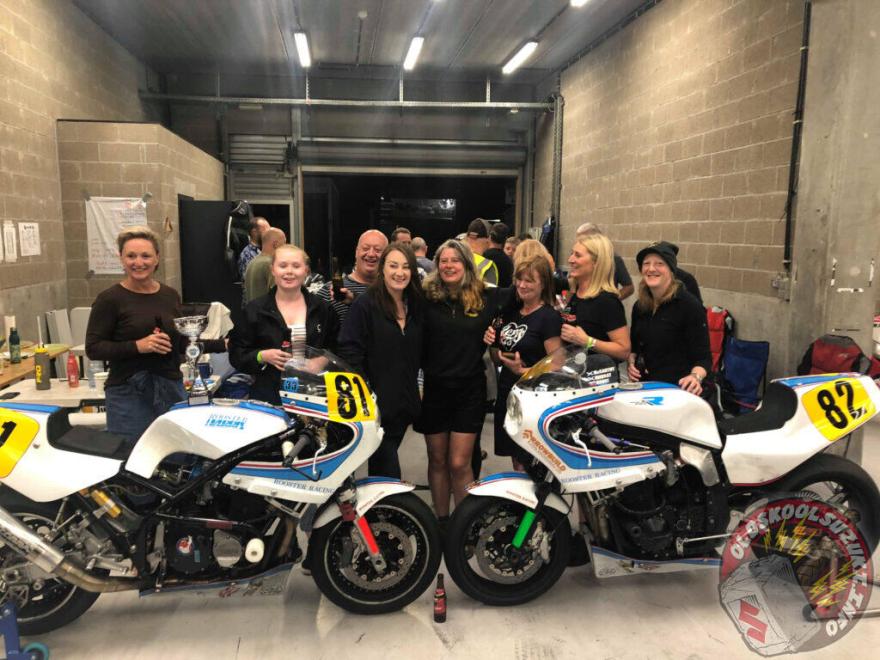
Rooster Racing’s bike 81 and bike 82. The GSXR 1100 powered Harris Magnum and the GSXR 1100 slabside are my firm choices for Bikes of the month for August 2019.
Rooster Racing GSXR1100 Harris Magnum and GSXR1100 Slabside
This will come as no surprise to those of you who followed my write up on Rooster Racing at Spa last month. We normally choose a single bike for bike of the month but the truth is, they both now hold a special place in my heart and a special place in the oldskoolsuzuki Winged Hammer’s hall of fame.
Rooster Racing team 81 and 82 Spa 2019
Rooster Racing Oldskoolsuzuki Winged Hammer
Rooster racing Angus Green GSXR Harris Magnum Spa 2019
Both bikes boast in excess of 165 BHP at the rear wheel, they are peppered with hand made functional engineering and they have one of the loveliest and well executed paint schemes you’ll find.
Rooster racing GSXR1100 Slabside Spa 2019
They were built with a single purpose in mind and they fulfilled that purpose admirably.
Rooster racing GSXR Harris Magnum Rooster Racing GSXR 1100 Slabside
Don Hill and Rooster Racing you built our very first Bikes ( plural) of the Month.
When you have a gift for getting the very best from a GSXR1100 engine the easy thing to do would be to just build them for other people and never leave your workshop. If that was what Don Hill at Rooster Racing did, I wouldn’t have a story to tell and the lives of an eclectic group of people that came together to form the Rooster Racing family at Spa would be significantly more ordinary.
oldskoolsuzuki.info first featured a story about Don Hill and Rooster Racing earlier this year. I knew then that there was something special about Don’s ethos towards the engines and the bikes he built. I also recognised that Don chose the riders he built them for very carefully too. I said I would return and find out more about Don’s work later in the year. At the that time, I never imagined I would get to know Rooster Racing quite as well as I have nor could I have known just how involved I would become in Rooster Racing’s fortunes. What I have learned since then, has only gone to reinforce my view that Don Hill and Rooster Racing are true unsung heroes in the growing world of post classic racing.
Race day minus – 3 months
My tale begins with an engine failure. The engine was the 1216 bandit engine in my own GSXR1100 slabside race bike. It was the first race of the 2019 season in April and I had spun a shell on the 3rd lap of my final race. Head in hands,with a full season ahead of me, I contemplated my next move. After a couple of days I got a call from Don. “what are you doing about your engine, apart from crying?” he asked. “I’m going to strip it and survey the damage”, I told him. “Bring it down to me”, he said reassuringly. “I’ll rebuild it and blueprint it so that it won’t happen again”. I politely declined, knowing that my budget wouldn’t stretch to a Don Hill Rooster engine. Don, then made me the sort of offer that I could not refuse. The engine was out and I was on my way down to Don’s days later. It felt like Jimi Hendrix had just offered to play at my garden BBQ for the price of a beer and a burger.
When I arrived at Don’s he was preparing his own 2 bikes for the 4 hour endurance race at Spa at the beginning of July. This made his charity seem even more generous. Both race bikes were undergoing a full rebuild and repaint. In typical Don style he was doing everything himself. It was a mind blowing amount of work for one person to be doing. He was also fabricating his own speed fuel loader for the endurance race. Once again Don’s approach was to avoid expensive costs, he couldn’t cover by fabricating parts himself. My mind boggled at what Don had already done and what he still had to do.
Rooster Racing GSXR engines
Despite everything Don had going on, in the 2 hours it took me to drive the van home, Don had stripped my engine and sent me a list of parts I needed to source. Over the next month or so I sourced the parts and in the meantime, Don also ported my cylinder head and fitted new Hyabusa rods, new cams and some trick timing that necessitated pocketing my wiseco 1216 pistons. When the engine was complete Don almost apologetically said it’s not a full Rooster build but it will be good for a slack 150BHP. I remembered that Don’s engines routinely and reliably knocked out 165-170 BHP. Just knowing he had built it, gave me a newfound piece of mind that I had never enjoyed building my own engines.
Rooster racing 1216 GSXR engine
Race day minus – 1 month
Don and I kept in regular contact over the next couple of months and he would regularly send me updates on the Spa race bikes. I would admire his work and give him encouraging words. He was working round the clock, alone, often into the early hours but in typical Don fashion the finish and the high quality of what he was producing never faltered.
Rooster Racing Harris tank
I worried about how hard he was working and about how my own engine build might have distracted him and used up valuable and limited Rooster bandwidth. I told him I was worried about how much he had on and offered my support in any way I could. I think Don appreciated my concern but he had seen my engine building skills and probably considered my direct involvement a distinct handicap to the cause.
I was going to be riding from Edinburgh to Switzerland the week before Spa for a work thing, so I had agreed with Don that I would tag a few days at Spa on to my trip and cover the race and the Rooster Racing team’s fortunes for oldskoolsuzuki.info
Race day minus – 14 days
A couple of weeks before Spa Don sent me pictures of the bikes completed and ready to go. I felt a great sense of relief that he had completed the bikes. I had become emotionally invested in Don’s fortunes. It was at that point that I realised that the bikes and their prep were only the first hurdle for Don. After that would come the logistics of getting the bikes, and all of the equipment to Spa too. I marvelled at the ambition of the man. Despite the fact that he had bitten off, what looked like more than he could possibly chew, he never faltered.
Rooster racing Harris Race bike Rooster racing GSXR1100 slabside race bike
Race day – minus 5 days
On my last night in Switzerland I was packing up my panniers in my hotel getting ready to set off for Spa the next day and I got a message from Don asking me if I was still coming to Spa. I cheerfully replied that I had my press pass and I was due in Spa a couple days before race weekend. Don then then dropped the bombshell. “I need you to do me a favour” he asked. “sure” I causally replied, still packing my stuff. ” need you to manage one of the 2 teams.” Don said. ” I wouldn’t trust just anyone, but I would trust you if you were up for it” Don followed. What could I say? I had promised Don my help and here he was asking me for some. I didn’t hesitate and I said yes. Don explained that he had planned to manage one of the teams himself and his friend Keith would manage the other but he had realised that he really needed to focus on the bikes and if I managed the other team it would take a lot of pressure off.
I had the next couple of days to think that over. I reassured myself that although I was a novice racer, I had 25 years of management experience and that had to count for something. At the back of my mind was the nagging fact that I knew next to nothing about endurance racing and the rules that governed it. It was going to be a steep learning curve. I contemplated how hard Don had worked to get to Spa and I felt the weight of responsibility for supporting Don and the team.
Race day minus 2 days
I arrived in Spa and got set up at my chalet. I was staying with two friends Scott and Kat in a chalet we had rented together. Little did I know that I would spend virtually no time with my friends or at the chalet. My work with the team began on the Thursday with the setup of the garage. Either side of us were much larger and clearly better funded and equipped teams. They all had team uniforms and custom built team transport. In contrast we had a rented Luton van and the clothes we came in.
Rooster racing had entered 2 bikes into the 4 hour endurance event at Spa, Bike 81 was a GSXR 1100 powered Harris and Bike 82 was a GSXR1100 slabside. Both engines were box fresh builds and they were about to be mercilessly thrashed for four hours.
Rooster Racing Spa 2019
Rooster Racing GSXR1100 winged hammers oldskoolsuzuki.info
Don was keen to be left to concentrate on the bikes and I had to quickly figure out what the key deliverables were for team manager. Fortunately, Don was there to keep me right and I would soon be joined by Keith who would be managing team 82 and had managed the Rooster team at Donington previously.
I found out when I arrived that I would be responsible for team 81 on the Harris. The 3 riders were:
Angus ( Goose) Green of IG classic Superbike series fame. Howard Selby 80s and 90s TT competitor, Scottish Champion and 90s European 600 Supersport European Champion and Gordon Grigor, 80s TT racer and UK endurance champion
Rooster Racing Harris Spa 2019
Team 82 managed by Keith my counterpart, were riding the GSXR Slabby 1100 and the riders were:
Adrian (Mole) McCarthy, Scottish PCS champion, Gordon Murray Scottish PCS Champion and Timo Monot TT and Classic TT competitor with recent top 10 finishes under his belt.
Rooster Racing GSXR1100 Spa 2019Team Rooster Racing Spa 2019
So, it’s safe to say the teams riding experience and skills were something I shouldn’t have to worry about. It quickly became apparent that the organisers at Spa were not going to make team sign on and rider registration easy and this is where I would start to earn my share of the team catering. Team sign on was open and I and after an hour wait in the 30 degree sun and a 200 man rugby scrum through a single door, I successfully signed both teams on.
This is when I experienced my first managerial perk; The company bike. The sign on location was inexplicably 2 miles away from the garage and a lack of any clear information on the event would necessitate multiple visits to the sign on point for clarification sessions.
Race day – minus 1 day
It was now Friday and the rest of the team members were all present and accounted for. Keith my team 82 counterpart and I read the rules through together and made sure we knew where everyone needed to be and when.
Control and distribution of the correct passes and wristbands for each team member was my first task. We quickly learned it was better to have no pass on your vehicle than to have the wrong pass. I won’t bore you with the details, but the rider’s passes were labelled “Guest”. It took us a while to figure that one out and the catering vehicle pass was for a different car park some distance away.
I had to make sure the members of the team who would be in the box and on the pit wall had the correct combination of passes too.
In charge of the pit wall was Keith’s younger brother Kev and Don’s daughter Georgie. They were the real brains of the operation and while Keith and I held the titles of team managers Kev and Georgie were more often than not giving the whole team valuable direction.
The mechanics were led by team principle Don and consisted of Mel, Billy and Twig, our stand man.
Team Rooster racing Spa 2019
The wonderful Julie Harrison was responsible for feeding us all and we were very well looked after with regular buffets and hot meals. We were all so busy that most of the time we just ate on the hoof.
I also had a very willing assistant in the form of Lewis, Howard’s 13 year old son. He definitely had his eye on the company vehicle from the off which he enjoyed using on the regular missing rider missions that I sent him on.
Missing rider retrieval missions were a large part of the job on registration day and throughout the event. I would round up the 5 riders and one would be missing. We would find him and turn around and a different rider would be missing. This happened every 5 minutes for the course of the day but we finally we successfully registered the riders, got our rider 1, 2 and 3 arm bands, completed scrutineering, for bikes, riders and rider’s equipment. We then attended the compulsory team briefing. Failure to attend would result in penalties. We were now cleared to race.
The whole time Keith and I and the 6 riders were doing this Don and the other mechanics were working non stop on the bikes in preparation for practice and qualifying.
Team Rooster Racing Spa 2019
Keith and I put up some white boards and marked out the key times for Practice and Qualifying with the rider order. Kevin and Georgie had defined the pit board signals and we would test these out during practice.
The plan for the bikes was to use practice and Q1 to set the bikes up based on feedback from the riders after practice and then make adjustments in time for Q2.
There was a lot at stake in qualifying because there were more teams entered than would be allowed to start the race on the Saturday. At the same time Don’s orders were clear the race was the important part. He didn’t want anyone binning it during qualifying. To endure is to finish. At the same time, we had to make the cut.
The bikes were prepared, and the riders were ready. It was time for practice and Q1. As the riders left the garages, we crossed our fingers. As they returned, they gave their feedback and Don and the Mel made quite a number of adjustments. For most of the riders it was the first time they had ridden these bikes. Every other garage around us was similarly engaged in repair and adjustment in between practice sessions.
Gordon Murray Team Rooster racing GSXR1100 Spa 2019Howard Selby Team Rooster racing GSXR1100 powered Harris Spa 2019
Angus Green Team Rooster Racing Spa 2019
During Q1 Bike 81 had developed an intermittent misfire and we had only a short period of time before Q2 to resolve it. Don and Mel set about stripping the bike and quickly discovered a crack in one of the dyna coils. We then discovered the spare coils were back in the UK. As team 81 manager it was my job to find replacements, which we did. Both Gordie and Mole had their own bikes with them for the CSBK race on the Sunday. So we stripped the coils from Gordie’s bike knowing that the we could return them in time for his race. It was close though, too close for comfort. Don was literally tightening the seat unit as the last call for Q2 came over the tannoy.
Don Hill Rooster Racing Spa 2019
We made it! Angus came back in from Q2 with a thumbs up. Both teams had qualified adequately in 36th and 40th out of 64 teams. We used qualifying laps to calculate fuel use and ensure that we could allow enough fuel for 14 laps with a 2 lap margin in case a rider missed the board.
Don Hill Rooster Racing Spa 2019
During qualifying we practised our pit wall routine by asking riders to acknowledge the board with a leg movement. Our garage and pit wall position were at the far end of the pits and right in the braking zone of the start finish straight. This proved to be the worst place in the world to demand the rider’s attention, let alone ask them to take their foot of the peg.
We experimented with count down boards, black flags and fuel calls but we were just too close to the braking zone to get consistent results. Team 81 and 82 boards also looked too similar and this was causing confusion. In the end, after a rider meeting Georgie and Kevin came up with a simple way of differentiating the boards for 81 and 82 and with the riders feedback we agreed to only use the pit board when it was time to come in. (keep it simple) No other signals would be issued. Riders would look for the board at the beginning of the straight, if it wasn’t out, they would get their head down. If it was out, they knew they had to come in on that lap. If it was moving up and down, they knew they had missed the first signal and they had to come in immediately. We only had a 2 lap buffer so if they missed that, it was over.
That evening there was a mandatory twilight session so that each rider could practice a couple of laps with lights on. We decided we would use the sessions and change of riders to practice our pit stops and rider changes. We made up a large pit lane board so that riders would see our box and we marked the box with the front wheel stop position. We practised signals from the pit wall to team managers so that we knew when riders were coming in. We would have just over 3 minutes from the signal before the bike would arrive.
Adrian McCarthy and Don Hill Rooster racing Spa 2019
The routine involved the rider stopping and cutting the engine, the stand going on. The rider would get a tap on the shoulder from the stand man and then dismount. Don was first in flipping the gear change to the rider’s preference (road or race) after Don was clear, the fuel team would move in and refuel, with everyone else clear. Once the refuel team were clear, the next rider would mount the bike, the stand man would drop the stand, tap the rider’s shoulder and the rider would start the bike and off they would go. It’s amazing how easily things can go wrong in the heat of the moment. If a team got it wrong, it could mean a penalty on race day or worse still, injury for a team member or rider. The pit lane was busy with other bikes and other teams. My principle roll in all of this was install the discipline of the routine and make sure everyone knew the routine and was in position at each stage. Each time I got the message from the pit wall I would give the pit team and the rider the call to stand by and then watch for our bikes coming in. It didn’t take us long to get into a rhythm and by the 6th practice we were looking slick.
It was late and I decided not to ride my KTM back to the my chalet as it had developed a blown exhaust coming up through France and would likely wake the dead so I borrowed an air bed and sleeping bag from Rene, who was there for the track day and I slept on the garage floor. The team next door was working on into the night, but I was dog tired and soon passed out. Tomorrow was race day!
Race Day
I went back to my chalet early and showered and reported back to the garage early. The race was going to start at 6pm that day and Don and the mechanics were hard at work preparing the bikes when I arrived, as was every other team in the pit garages. Even Timo was hard at work cleaning the bike.
Timo Monot Rooster racing Spa 2019
I made sure I had all of the riders’ arm bands safe so that I could issue them in the correct order when the race began and made a few cheat sheets up for the front of the garage with key info.
Don, Keith, Georgie, Kevin and I discussed strategy for the first rider change, taking into account that the start would involve a couple of laps for the setup of the grid. We opted to bring both bikes in consecutively after just 11 laps and then at 14 lap intervals thereafter (all going to plan) What this meant was that the as soon as one bike had pitted we would have around 4 minutes before the next bike would pit. In that time the fuelling team would need to have refilled the fuelling tank and be back on point at the front of the garage. It was going to be tight.
Rooster Racing Spa 2019
The weather had been glorious up until this point but as the race start at 6pm loomed so did some very menacing clouds. As we approached the start some rain had begun to spit. There were a lot of nervous faces around, with the exception of our team which had a total of 4 Scottish riders. Scottish riders are used to rain. Mole looked positively happy and rubbed his hands with glee.
The mechanics and the number 1 riders made their way to the start line with the bikes. At Don’s request, I taped the starting grid positions to the top of the tanks to make sure that the bikes could be placed correctly on the grid. The last thing we wanted was a stop and go penalty over the wrong grid position. The start would be a traditional endurance start with the bikes on one side of the track held by the mechanics and the riders lined up on the opposite side. When the race starts the riders must run the width of the track mount the bike, start it and take off.
Don Hill Angus Green Rooster racing Spa 2019
I didn’t see the start as I was back at the garage nervously making sure that everything was in place for the first stop. I could hear the klaxon sound and I could hear the roar of the bikes as they took off. The race had begun!
Each manager was assigned a pit marshal who stood opposite the garage and watched every stop to ensure that the regulations were met. Each time a pit was completed, and a rider change was made Keith and I would sign off the change with our respective marshal. Each rider was required to do at least 2 sessions.
News was coming in of parts of the track being quite wet. It’s a long circuit at nearly 4.5 miles and while it was dry at the garage, we heard that there were some very wet spots at the far side of the track. By the end of the first rider session by Adrian for 82 and Angus for 81 we had moved up the standings to 18 and 24. It was a great start, but Angus had to be helped off of the bike. He had pulled both hamstrings when he lost his footing running to the bike at the start.
We swapped riders and refuelled both bikes back to back. the changeovers and pit stops went exactly as rehearsed and Gordie for 82 and Howard for 81 were away.
My attention now turned to Angus, there was a lot of bruising and swelling on the back of his legs and he was in a lot of pain. We organised some ice and I began to worry I would be one rider short. Angus and I decided we would wait until 15 minutes before he was due to ride again before making an assessment. I called upon my Marshal and asked him if he would object if I changed my rider order. I was relieved when he told me I could put the riders out in any order. This gave us the option of leaving Angus until last. Howard and Gordon Grigor agreed that they would be happy to reshuffle.
We were an hour and a half into the race when our second change came in and our positions remained in and around the top 20. Our strategy to do both bikes back to back gave the fuel team virtually no time to refill and be back on point for the next rider but Mel, Billy and Twig never gave us a worry and they did brilliantly. In between changeovers I was in constant contact with the Kevin and Georgie on the wall as they were keeping count of laps and times. Keith my fellow manager was monitoring live lap times on-line and keeping us all informed of progress.
Our 3rd riders Timo for 82 and Gordon Grigor for 81 both got away well with a faultless changeover and pit stop. Gordie Murray reported that the clutch had gone on 82 the slabby. He was forced to clutchlessly change gear. There was no chance to stop we simply had to carry on and hope that it would hold out. Mid way through Timo’s stint we got the shout from the pit wall that 82 was coming in for an unknown reason mid-session. When Timo pulled in, we quickly learned that the quick change gear lever had lost its R clip. No doubt clutchless gear changes may have been a factor. Quick as a flash the pin was replaced, and Timo was off, but we had worked our way up to 11th overall prior to the gear change issue and the stop cost team 82 six places.
I had been timing the rider pit stops with Lewis’s help mainly to get the exact time they went out and came in. I was using this to get an idea how long each rider would take to complete the 14 laps and then make the in lap. This gave me the ability to predict when the next change would be. As Angus’s next ride approached, I asked him if he was going to be able to ride. To my surprise and delight he said yes, he was going to give it a go. So, Angus and Adrian were back out and we had six changes and 4 more changes to do. Both bikes were going well but the slabby clutch was a concern and so was Angus’s injury. Team 81 was sitting in 16th and team 82 in 17th
All around us bikes were coming in smoking or leaking or both and some had already been retired. The pit lane was a constant hive of activity all closely monitored by a line of eagle eyed marshals. Race bikes take a punishing at the best of times. Tuned to the point that makes them highly strung and delicate they are normally thrashed for 10 laps at a time, allowing for checks in between. Endurance racing was a bigger test. These same highly tuned bikes were going to be run flat out for 4hrs and over 350 miles. All around us the thrashings were beginning to take their toll.
Each time the riders came in they looked sweaty, wide eyed and exhausted. Spa is a long track with 20 corners. Doing 14 flat out laps of this track was physically demanding in the extreme.
Remarkably, despite his injury, Angus was doing well, he was putting in decent times and it looked like he would complete his stint. Adrian was putting in great times too and both bikes were well placed. We had to make a decision on how we would split the last two sessions as we had calculated there would not be enough time for a full 14 laps each for the last 2 riders in each team. Both teams took a slightly different approach but team in team 81 we decided to split the last 2 sessions equally so Howard and Gordon Grigor would do 11 laps each.
I was relieved when we got our last riders out, but it was clear from the times we were putting in that we were in with a real chance of a top five finish in our class. I signed my last pit stop record and my Marshal extended his hand and congratulated me on a well-run pit.
As the pit crew relaxed slightly knowing that our last riders were out, all we could do was watch the times and hope the final session would go without incident. It was at this point that Don turned to me and said ” I think we should try a 12 hour race next time” I think he was serious. I just laughed nervously.
When the race finished, it was confirmed that team 81 had a podium finish with 3rd in the open class. Team 82 had managed a fourth place finish in the open class, despite the unscheduled stop for the gear change fix. We worked out that had it not been for that extra stop Rooster Racing would have been celebrating a second and third in the open class.
It had been a long hard 3 days and all of a sudden it all felt very worth it. I took the time to shake each of my fellow team members by the hand and I could see in every set of eyes I met there was the same look of elated happiness that I was feeling. The whole team made its way to the podium together for the presentation.
When we got down to the podium, we noticed that we had lost Howard and my last find the missing rider mission of the weekend began. I delivered Howard to Don and the rest of team 81 just minutes before they stepped out on to the balcony for their podium moment.
Team 81 Rooster racing Spa 2019
Kevin, one half of our pit wall brain trust began chanting “Rooster, Rooster Rooster, Rooster” within a couple of seconds most of the crowd joined in. There it was, the defining icing on the cake, Don, Angus, Gordon and Howard standing up on the balcony holding their trophies while the Spa crowd chanted the team’s name Rooster, Rooster, Rooster.
We moved the bikes back up to the garage and the beers and the whisky began to flow.
Team 81 Rooster racing Spa 2019
We arranged the bikes for a series of photo shoots and Rene, who had now become an honorary member of Rooster racing family, took everyone’s camera and or phone and took a series of group shots with the entire team while he wobbled precariously standing on a chair.
Team Rooster racing Spa 2019
As the beer began to take the edge off of a tense day, I looked around me at my fellow team members, most of whom had been strangers only 2 days earlier. Now we were a team, galvanised in the heat of battle and righteous in victory. We felt like a team that night and we celebrated as a team. Even Don was smiling. If you know Don, you will know this is rare. There had been no egos just a group of people working together to make the race team work.
Team 81 and 82 Rooster racing Spa 2019 Left to right Gordon Grigor, Howard Selby, Angus Green, Don Hill, Adrian McCarthy, Gordon Murray, Timo MonotRooster Racing Spa 2019Team 82 Rooster racing Spa 2019Rooster Racing Spa 2019
I looked at the 2 bikes that just four hours ago had looked so pristine. They were filthy covered in oil and rubber. They had survived. They had endured and this was the ultimate testament to Don’s work and the efforts of our six riders. With very little money and a hell of a lot of hard work and talent Don had single handily created the opportunity for this moment to take place. His engineering had been tested and found to be of the very highest order. His choice of riders had also been rewarded.
Rooster racing Spa 2019Rooster racing GSXR1100 Spa 2019
Some time ago Don had decided he would build 2 bikes to take part in this event. He put the riders and the team together and he hand built the bikes. The choices he had made, the sacrifices he had made, and all of his hard work had been rewarded. I knew Don well enough now to know that he always had a point to prove. The point being that you don’t need a mega budget and celebrity riders to get a result, but you do need a talent for building fast reliable bikes and a nose for the right kind of riders and people. While we all celebrated our shared success that evening and our own part in that success, there was no doubt in anyone’s mind that there was one man who was pivotal to that success and that was Don Hill. This had been his vision from the start and our success represented a very personal struggle fulfilled.
Don Hill, Rooster Racing, Spa 2019
I was honoured to have been able to take part and I was grateful to have been allowed to share in the success and I knew everyone else in the team felt the same way.
The evening ended with a country music rendition of ice ice baby by Gordie on the guitar. I’m still trying to forget that bit but I know I will not easily forget how special my time was with this wonderful group of people at this amazing race track.
Comments Off on Oldskoolsuzuki meets Don Hill at Rooster Racing
At the end of January I got a chance to go and visit a man who has probably forgotten more about building and tuning 90s GSXRs than most of us will ever know. His name is Don Hill and he owns Rooster Racing.
What made this opportunity to visit Don’s workshops special was that it’s not something he offers very often. He is almost adverse to attention and publicity, preferring to hand pick the people he builds bikes for. The reason for Don’s approach became clearer as the day wore on.
Don Hill and the Rooster Racing team at Donington endurance legends 2018
Don Hill
I first became aware of Don’s work when my friend Adrian McCarthy (AKA Mole) told me he was going to be one of 3 riders racing Don’s Rooster Racing GSXR powered Harris at the 2018 endurance legends event at Donington. When I was there, I got a quick look round the bike in the pit garage. The build quality and the finish were something very special.
That same year I started my own race career ( if you can call it that). Racing at Eastfortune on my home built GSXR1100 Slabside. I quickly learned that 3 of the fastest GSXRs in my post classic senior class were all built by Don at Rooster Racing. I would like to say that’s why they were so much faster than me but the truth was that was entirely down to me. With Don’s Slabside based 1216 engines routinely and reliably knocking out over 160 bhp, I can’t see my home built Slabby getting close even if my riding skills improve.
Adrian’s Championship winning GSXR1100 slabside built by Rooster Racing
I got chatting to Don in the pits at Eastfortune last year between my races. I had been suffering from some fuelling problems and Mole and I and the rest of the team had been struggling to solve the problem. Don turned up and took around 2 minutes to sort it. We chatted again after my last race and he agreed that I could come down and learn more about what he was doing and write something for OSS.
Rooster Racing
There were two main reasons I was intrigued to know more about Don’s work. Firstly, I was impressed by the performance and the reliability of the engines he was building. Secondly, Don’s talents don’t stop at engine building and tuning. He fabricates the frame and swingarm modifications, builds his own exhausts systems and as if that wasn’t enough, he produces the most amazing paint work too. There aren’t may people who can single-handedly build a race bike to such a high standard. I just needed to know more.
Mole was going down to Don’s to pick up freshly painted body work and wheels for his 2019 wet bike. So I hitched a lift down to meet Don on his his home turf and learn more about the work that he does.
When we arrived Don took us into his main hanger size workshop, he put the heating on and then presented us with us with tea and bacon butties. I liked him already.
While Mole and Don talked I had a wander round looking at some of the motorcycle exotica that peppered the workshop.
Don and Mole talk shop
GSXR Engine tuning
Don was in the midst of building a new Machine shop for his gas flow bench. The flow bench was situated in another location until Don has completed the extension. Don promised me a return visit when all of the work was complete so that we could do a more detailed feature on it.
,We talked about his fastidious approach to head work. He will routinely spend 200 man hours on a head between porting it and gas flowing it. When we talked about costs, I quickly worked out that he probably ends up earning about £3 an hour on a head. It was at this point that I started to realise Don was an out and out perfectionist. He was not motivated by cost or profit. His motivation was quality. This was not Don’s day job either.
Don explained his method of gas flowing a cylinder head. Don would always gas flow with the carbs on. Not any old carbs but the actual carbs that were going to be used on the bike. He acknowledged that everyone had their own approach but this was his. Engines were built to each racers specific requirements. Those requirements often came down to where the bike would be raced and how and where the rider wanted the power to develop. No one engine would be the same.
Don explains the varying engine characteristics that he has tailored for different racers
GSXR frame fabricaion
Don had a GSXR slabside that he was mid way through building for a racer from the ground up. This included all of the frame and swingarm mods and a very trick aluminium breather tank.
Ground up Rooster Racing GSXR Slabside race bike
GSXR exhaust fabrication
Don then talked us through the exhaust systems that he builds to go with his engines. He talked about about the importance of narrowing the headers at the manifold and ensuring that the pulses from the matched cylinders worked in unison at the collector box. I was out of my depth but I nodded like I understood.
Rooster Racing’s hand made exhaust systemsDon explains the virtues of collector box configuration
Rooster Racing paint
Mole’s freshly painted body work and wheels were laid out for collection and they were perfect. Don was clearly a man of artistic talents too as he explained his love for ornamental wood carving and shared some pictures of his work. Looking closely at the paint work than Don had completed for Mole, it bore all of the hallmarks of a perfectionist, just like everything else that Don put his hands to.
Mole inspects his new paint job by Don Hill
Quality and integrity are inseparable
As the morning wore on and Don and I talked some more I realised what a rare individual he was. When I say this, I mean Don seemed to be able to bring the the same methodical, well rehearsed quality, to everything he did. There was also something unique about the way Don viewed the bikes and the riders that he worked with.
When he built a bike for someone he maintained an genuine ownership like concern for the bike and the rider’s fortunes. This was the reason Don chose those who he built for so carefully. He had to be sure that they the rider would be prepared to do things Don’s way. He doesn’t build parts of bikes, he builds a complete performance package. The performance came from each part of the bike working in unison.
Mole was a trained motor mechanic and was no stranger to building his own machines. He had won a number of championships on his own builds but since meeting Don he now deferred to Don on all major decisions on race bike performance. As Mole put it “when Don tells you to do something you don’t argue you just do it”
Rooster Racing’s Harris Endurance bike
I left Don’s workshop with a deep respect for his skills and his ethos. Don understood the high stakes for a racer, having raced for many years himself when he was younger. Racers had partners and families to provide for. The performance, reliability and ultimately the safety of the machines Don built meant more than just winning. Lives were at stake and that responsibility was something that weighed heavily on Don’s conscience.
I concluded that Don was a man of great skill, who would always put quality first. He would never be afraid to walk away if he felt that his approach was unwelcome, unappreciated or compromised. His commitment to that approach and his integrity left me feeling that I could implicitly and completely trust Don. I can’t think of a more important time to trust someone than when they’re building you a race bike.
Oldskoolsuzuki will return to Rooster Racing later in the year. In the meantime, don’t call Don, he’ll call you.
Privacy & Cookies: This site uses cookies. By continuing to use this website, you agree to their use.
To find out more, including how to control cookies, see here:
Cookie Policy